Back to Blog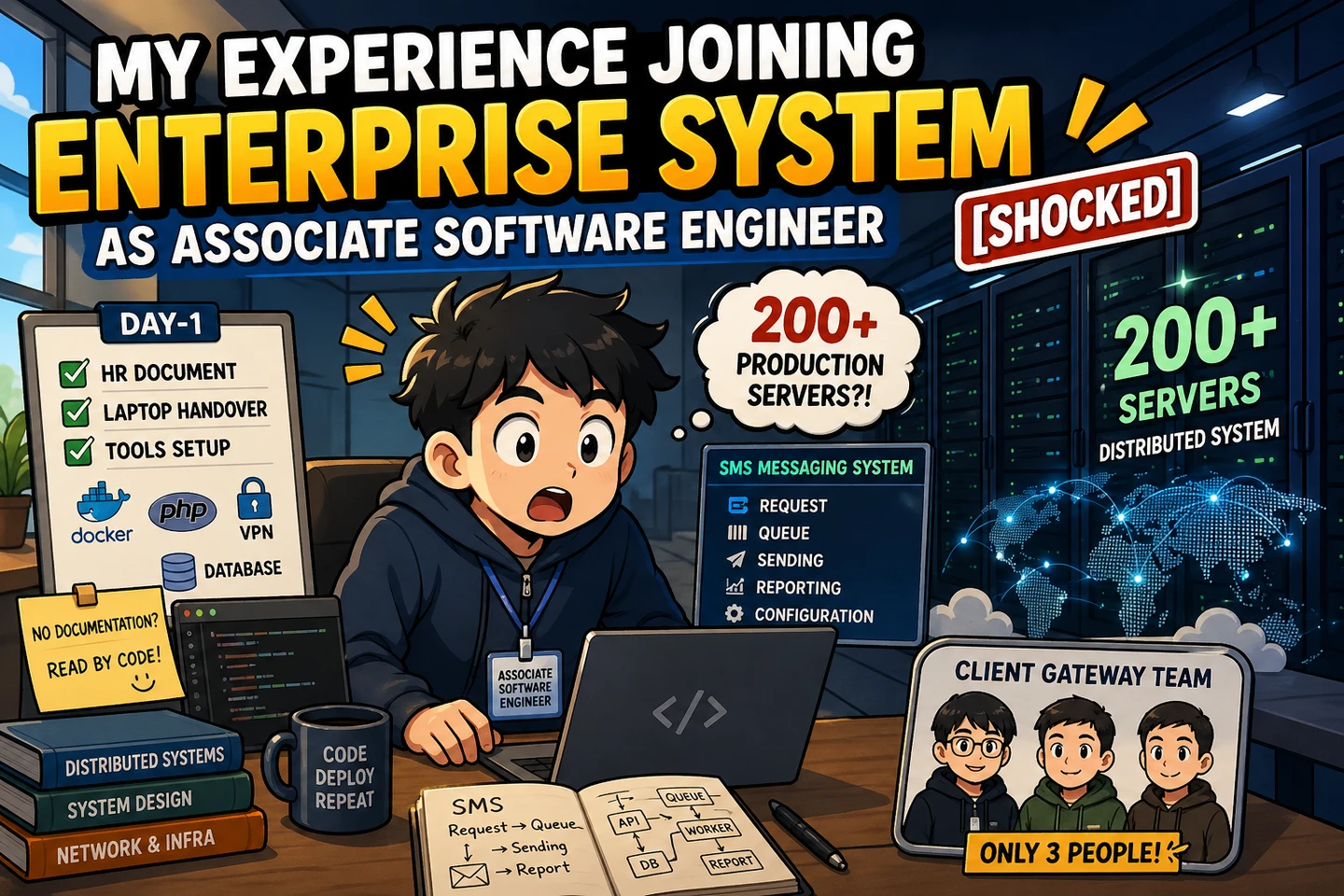
CareerStory
Career
Experience
Software Engineering
My Experience Joining an Enterprise System as an Associate Software Engineer
December 20242 min read
Hello everyone,
I want to share one of the most memorable experiences at the beginning of my software engineering career.
After graduating from university, I spent several months searching for a company before finally getting accepted as an Associate Software Engineer in 2024 at my first full-time company.
First Day: A Familiar Start
On my first day, everything felt quite normal. I completed HR administration, received my work laptop, met my manager and team lead, and started setting up the company environment and development tools.
The setup included tools and services I was already familiar with from previous freelance and corporate projects, such as:
- Docker
- PHP environment
- VPN access
- Database setup
- Internal tools and configurations
So, the first day did not feel too overwhelming.
I also asked my manager several questions:
- How does the engineering ecosystem work here?
- What kind of projects would I handle?
- Who would I work closely with?
- Was there any documentation I should read first?
Interestingly, my manager told me that there was almost no formal documentation, so most knowledge had to be learned directly from the codebase.
That answer surprised me a little.
Second Day: Entering the Real Enterprise Environment
On the second day, I met one of the senior software engineers on the team.
He took me around the office to introduce me to other teams and coworkers. Some faces were already familiar because I had met them during the onboarding session with HR the day before.
After the introductions, we had a one-on-one discussion about the systems they managed and the responsibilities I would eventually handle.
That was the moment I realized this company operated on a completely different scale compared to anything I had worked on before.
It was my first time seeing a distributed system running across hundreds of servers. From what I remember, there were already more than 200 production servers actively running.
As a fresh graduate, that number felt massive.
Learning About SMS Messaging Infrastructure
My senior engineer understood that I was still very new to enterprise-scale systems, so he started by explaining the core business: an SMS Messaging Service platform.
At first, I thought SMS systems were simple.
But after listening to the explanation, I realized how complex the ecosystem actually was.
The platform handled:
- Request processing
- Queue management
- Temporary data storage
- Message routing
- Delivery reporting
- Client configuration
- Retry mechanisms & Failure handling
- High-availability systems
- Logging schema & monitoring system
What impressed me the most was how clean and structured the data flow was. The system was designed to maximize delivery success rates while maintaining stability under heavy traffic.
It completely changed how I viewed backend engineering and distributed systems.
"No Documentation" … Turns Out There Was
Interestingly, my senior engineer later gave me access to a documentation folder.
So technically, documentation did exist.
The documents mostly contained technical handover notes from previous engineers, architecture explanations, and operational guidance. It was not perfect documentation, but it was still extremely valuable for understanding the system.
Compared to starting from zero, it helped a lot.
My First Real Task
Not long after that, I received my first task.
I was asked to build a small endpoint for handling SMS requests. The goal was simple:
- Receive the SMS request
- Process the request
- Generate reports
- Successfully send the message to my phone
Even though it sounds simple, for me it felt exciting because it was connected to a real production ecosystem.
During my probation period, my senior engineer also invited me to participate in nighttime deployments. Fortunately, I was already used to staying up late from previous freelance projects, so adapting to deployment schedules was not too difficult.
Transitioning Into Real Production Work
After around one or two months — I honestly forgot the exact timing — I started handling actual client-related tasks for the SMS messaging system.
At that point, things became much more serious.
The work was no longer just about creating features. It involved:
- Understanding production traffic
- Maintaining stability
- Monitoring delivery reports
- Managing server behavior
- Investigating failures
- Supporting enterprise clients
Three months later, after finishing my probation period, I was officially accepted as a full-time engineer on the team.
One of the Most Valuable Experiences in My Career
Looking back, this experience became one of the most valuable learning phases in my career.
Previously, in freelance and smaller projects, I usually handled only one or two servers with separate applications.
But in this company, I was suddenly exposed to a distributed infrastructure with hundreds of servers, complex processing pipelines, and large-scale operational systems.
The entire ecosystem was fascinating:
- Requests
- Temporary processing
- Queue systems
- Sending pipelines
- Reporting systems
- Configurations
- Multi-server orchestration
Everything had to work together reliably.
I also realized that many of my friends in other corporate environments handled much smaller infrastructures, so being trusted to work inside this kind of system as an associate engineer made me feel incredibly proud.
By the way, the team name was the Client Gateway Team.
And surprisingly, the entire team only had three engineers.