Back to Blog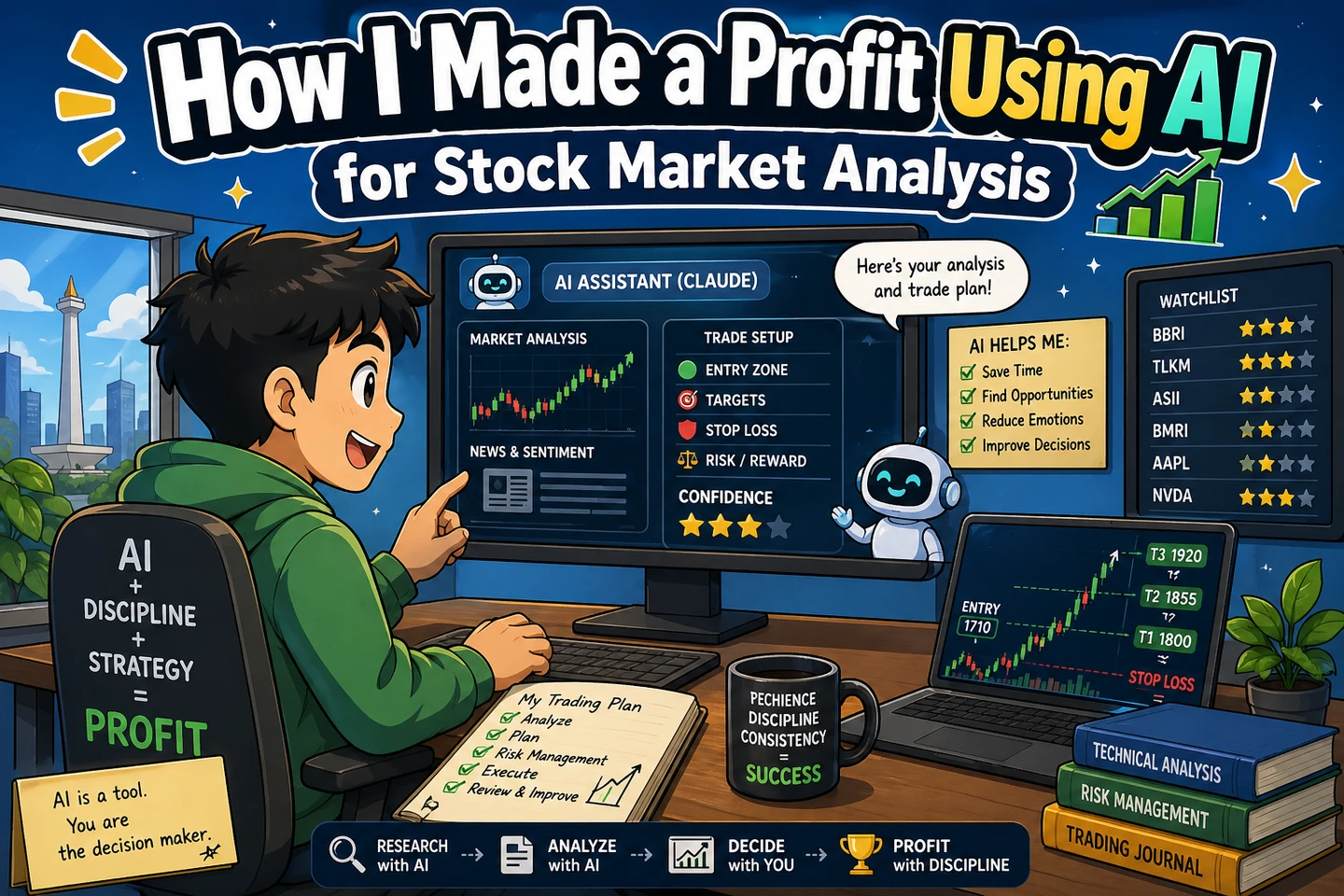
StockStory
AI
Stock Market
Investment
How I Made a Profit Using AI for Stock Market Analysis
April 20262 min read
Hi everyone,
I want to share my experience of using AI to help analyze the stock market and support my trading decisions. The main AI tool I use is Claude by Anthropic, and so far it has been surprisingly helpful for research, market analysis, and trade planning.
I currently use the paid subscription version, which costs around $20 per month. For me, it has become more than just a chatbot — it acts like a personal trading analysis assistant.
How It Works
I created a custom instruction workflow that tells Claude to behave like a trading analyst assistant. Its responsibilities include:
- Analyzing market news
- Screening potential stock opportunities
- Summarizing entry and exit signals
- Identifying risks and market sentiment
- Creating trading summaries and watchlists
At the moment, I mainly focus on the Indonesian stock market, but sometimes Claude also identifies interesting opportunities in the US market.
I also implemented a confidence rating system using a simple 1—3 star scale, which helps me quickly understand how strong a setup looks based on the current market context.
At the end of every analysis session, I ask Claude to generate a spreadsheet-style summary containing:
- Entry zones
- Exit targets
- Stop-loss levels
- Risk-to-reward ratios
- Market context
- Watchlists
- Additional supporting data
This makes the information much easier to review before making any decisions.
How Claude Collects Data
Claude gathers information through web searches, financial APIs, and publicly available market data. It combines technical analysis, news sentiment, and macroeconomic context to generate insights.
Sometimes, if additional clarification is needed, I also provide screenshots of charts or trading setups so the AI can analyze them more accurately.
Avoiding Hallucinations
Large Language Models (LLMs) are AI systems designed to predict the next most likely word in a sentence. Because of this, hallucinations — incorrect or fabricated information — can still happen.
That is why clear instructions are extremely important.
To reduce hallucinations, I always:
- Give detailed and structured prompts
- Ask the AI to explain its reasoning
- Double-check all important data
- Verify the results using external platforms
AI should be treated as an assistant, not as a fully autonomous decision maker.
Making the Final Decision
After Claude finishes generating a report, I manually review everything before taking action.
I usually compare the analysis with other platforms such as:
This helps me validate the setup and avoid blindly following AI-generated recommendations.
At the end of the day, the final decision still depends on my own judgment and risk management.
My Real Trading Experience
Before using real money, I first tested several stock recommendations provided by Claude. I reviewed the results the next day to see whether the setups actually played out.
Out of 10 recommendations, around 7 moved according to the predicted direction — whether toward profit targets or stop-loss zones. That result gave me enough confidence to try using a real position.
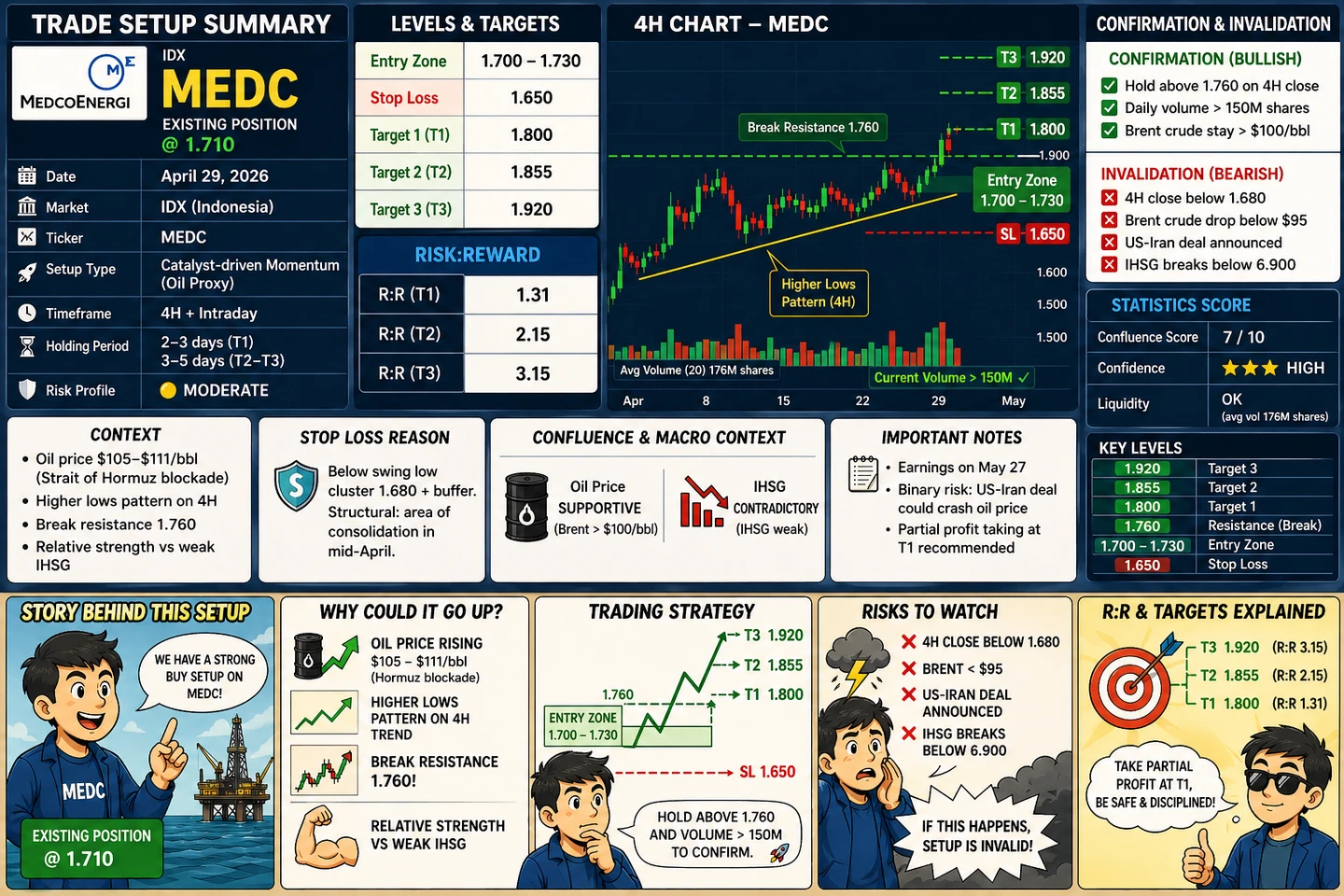
The next day, I asked Claude to analyze the market again. It provided:
- Entry price
- Profit targets
- Stop-loss level
- Market context
I waited patiently for the setup to trigger. A few hours later, the stock finally entered my planned entry zone — exactly as expected.
I immediately prepared a stop-loss to protect against the worst-case scenario.
The following day, the stock successfully reached Target 1 with approximately 5% profit. However, instead of taking profit immediately, I only took a screenshot of the result (LOL).
The day after reaching Target 1, the stock started pulling back slightly. Even though my position was still in profit, I became unsure whether I should continue holding.
So I asked Claude for another analysis.
The AI suggested that the momentum was weakening and recommended either:
- Taking profit around 1%, or
- Continuing to hold while maintaining a disciplined stop-loss setup
I decided to continue holding the position.
A few days later, the stock moved higher again and my unrealized profit increased to around 3–4%. I asked Claude to reevaluate the situation and update the expected targets.
Interestingly, the AI maintained the same original target levels and still believed the setup had room to continue.
So I stayed patient.
Eventually, the stock reached the target successfully — and I finally secured the profit.
Trade Result
| Action | Price |
|---|---|
| Buy Entry | 1710 |
| Target 1 | 1800 |
| Target 2 | 1855 |
| Target 3 | 1920 |
Final Thoughts
AI is not magic, and it cannot predict the market perfectly. However, when combined with proper research, risk management, and human judgment, it can become a powerful assistant for traders and investors.
For me, AI helps reduce emotional decision-making, speeds up research, and improves overall trading discipline.
But one thing remains important:
Never rely on AI blindly.
Always verify the data, manage your risk carefully, and make sure you fully understand every trade you take.